Branco Weiss Fellow Since
2026
Research Category
Theoretical astrophysics, cosmology, gravitational waves
Research Location
University of Oxford, United Kingdom
Background
Gravity is the first fundamental force of nature to be discovered by humankind, and yet, many aspects of its behaviour are poorly understood. Gravitating systems of many bodies, like the dark-matter environments of galaxies or clusters, or stellar clusters inside galaxies, exhibit universal phenomena regardless of their size. The nature of dark matter itself, despite accounting for most of the mass in the Universe, remains unknown. These universal patterns have been observed in computer simulations for decades, but their physical origin remains a mystery. At the same time, increasingly powerful astronomical surveys are providing unprecedented data on the distribution of matter throughout the cosmos. Understanding how complex gravitational systems evolve from simple initial conditions has therefore become one of the central challenges of modern astrophysics. Recent advances in kinetic theory, statistical mechanics, and high-resolution numerical simulations now make it possible to revisit these long-standing questions from a fundamentally new perspective.
Details of Research
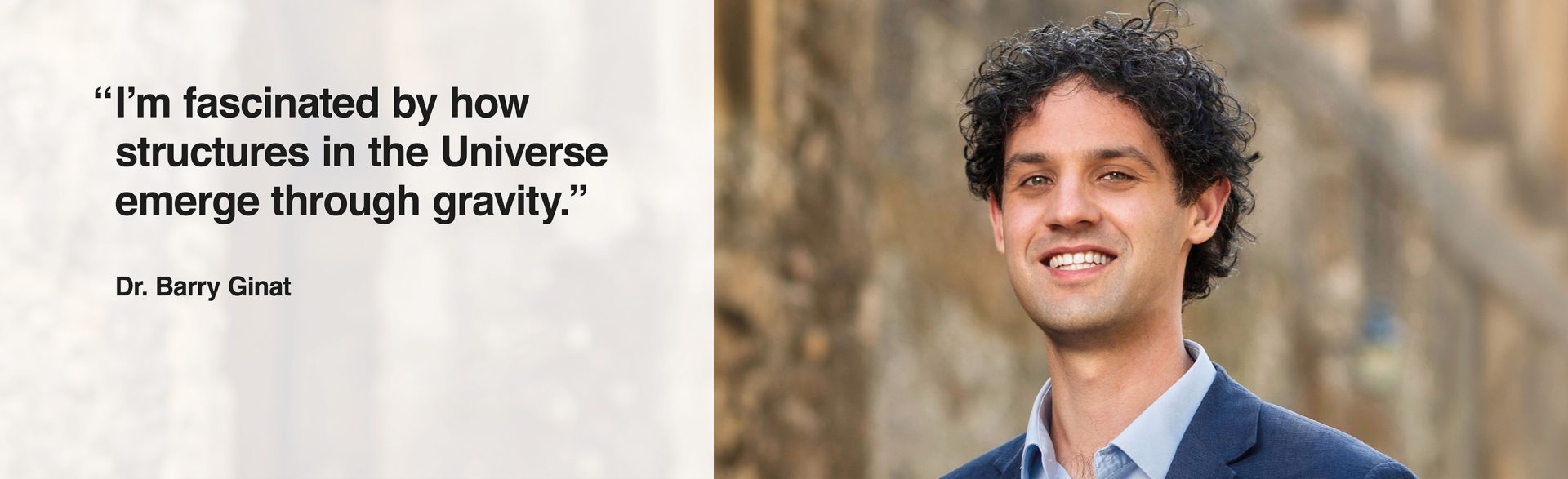
Dr. Ginat aims to develop a phase-space description of structure formation in gravitational systems that goes beyond conventional approaches. Drawing on concepts from plasma turbulence and statistical mechanics, he seeks to understand how gravitational systems relax, mix, and evolve toward universal equilibrium states. His project combines analytical theory with computer simulations and explores both conventional cold dark matter and alternative dark matter models. Ultimately, the research seeks to explain why dark matter haloes throughout the Universe (and other systems) share common structural properties and what information about the early Universe survives within the highly non-linear stages of cosmic evolution.